

Brazilian technology that is transforming national fish farming.
Brazilian technology that is transforming national fish farming.
Brazil has the largest freshwater aquaculture potential in the world. The reservoirs of Brazilian hydroelectric plants have an estimated carrying capacity of 4 million tons of fish per year. Currently, we utilize less than 4% of this potential.
The Fisher TRGV (Large Volume Net Pen) was designed with the aim of solving the main challenges of net pen production in order to unlock this enormous potential.
In partnership with APTA-SP and the Fishing Institute, Fisher developed this exclusive, patented technology, fully adapted to the characteristics of Brazilian reservoirs.
By combining the concepts of economies of scale, risk minimization, greater control and precision in feeding, and increased animal welfare, TRGV Fisher is revolutionizing the way fish are produced in Brazil.


Technical characteristics of the TRGV FISHER
Volume: 450 m³
Production capacity: 30 t/cycle
Population: ~35,000 individuals
Stocking density: 60 - 70 kg/m³
High-frequency automated feeding
Individual silo per tank with a capacity of 1.2 tons of feed (3 to 10 days of autonomy).
Tank structure: aluminum
Screen: stainless steel, 1.2 mm wire coated with PVC.
Double flotation system

Advantages of the TRGV FISHER
Larger scale and greater operational efficiency Greater production performance Greater structural safety
BIGGER
Better feed distribution Better feed conversion Better zootechnical control Better process automation Better fillet yield
BETTER
Less competition among fish Less environmental impact
LOWER
REDUCTION
Reduction of visceral fat Reduction of feed losses Reduction of operational costs

Structure and operation
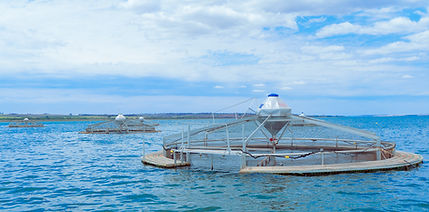
Inspired by the concept of cattle pens and submarine flotation systems, the TRGV has an automated individual silo with the capacity to store up to 1,200 kg of feed, guaranteeing supply autonomy that can vary from 1.5 to 4 days, depending on the growth phase of the fish.



Smart nutrition
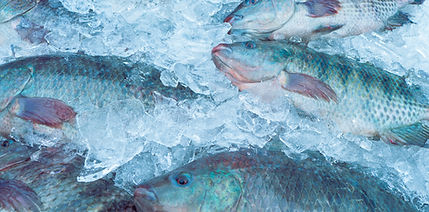
The system's key advantage lies in its intelligent and continuous feeding. While conventional tanks feed the fish only a few times a day, the TRGV system distributes feed every 15 minutes, totaling 48 daily feedings for schools of 40,000 to 80,000 tilapia.

Dual system
of buoyancy
The TRGV Fisher's double flotation system is a unique innovation on the market that allows large-volume tanks to be lifted for cleaning and screen maintenance at the end of each cycle. This feature is crucial for locations where golden mussels are present, as is the case in most Brazilian reservoirs. In this system, all cleaning and maintenance takes place with the tank out of the water, without the need for divers.


Implementation and operational support
Fisher believes that the Fisher TRGVis the most suitable technology for large-scale production in reservoirs and has the potential to transform national tilapia production.
In addition to the technology, Fisher offers complete support for the implementation and operation of the TRGV system, assisting companies in all stages of the production process.
For more information, please contact our engineering team.